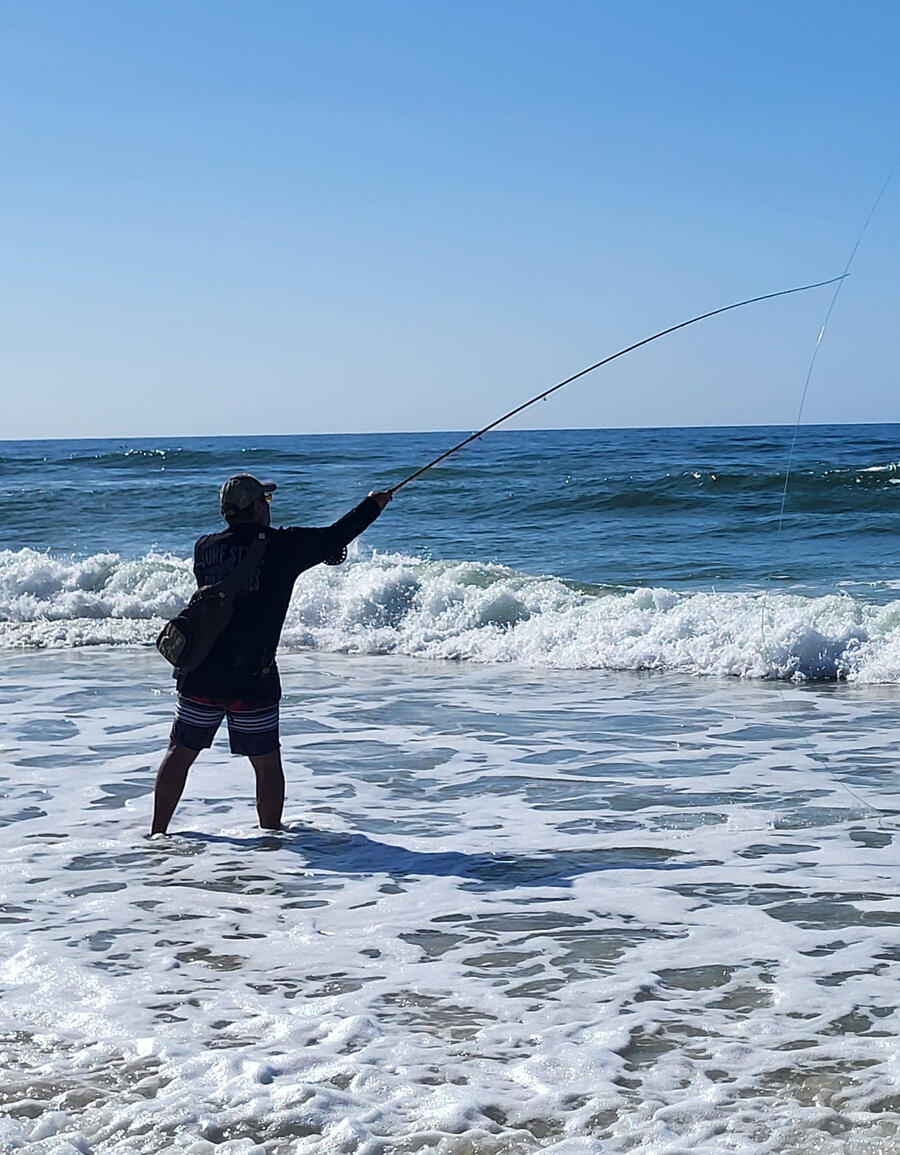
SURF SPEY STANCE AND ALIGNMENT OPTIONSOPEN OR CLOSED
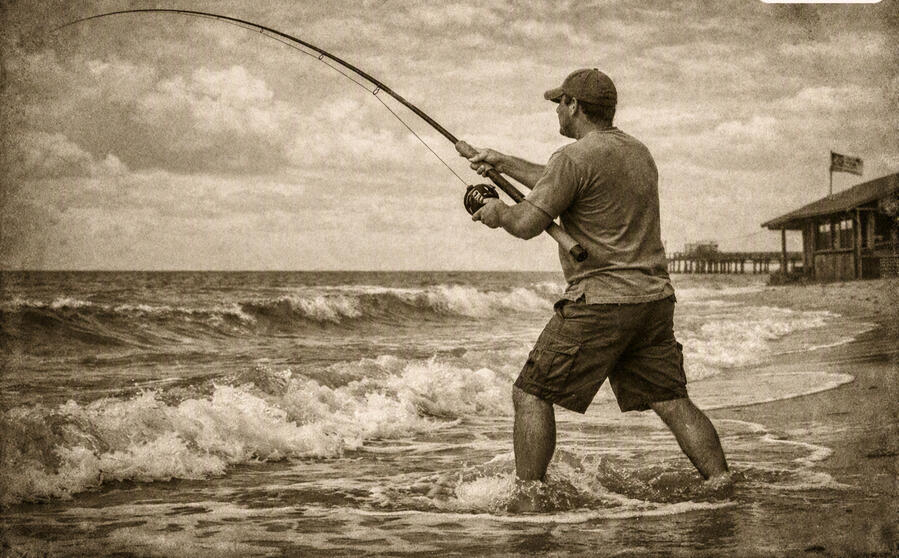
By Mark SeverinoSurf Spey casting begins at the feet. Before the Sweep, before the Turn, before the Drift or the Delivery, the stance and alignment determine the geometry the rod tip can travel.There is no single “correct” stance. There are two valid options - open and closed -and each creates a different mechanical profile.This article defines both stances, explains how each affects the rod tip path, and helps the caster choose the stance that best supports their stroke.THE PURPOSE OF STANCE AND ALIGNMENTStance establishes:
• balance against wave surge
• rotational freedom
• the rod tip’s natural tracking laneAlignment establishes:
• the forward stroke plane
• the target line
• the apex height
• the direction of the inward PullTogether, stance and alignment form the geometric base of the cast.THE ALIGNMENT CHAIN
Regardless of stance, alignment requires four elements to match:
1. Feet
2. Hips
3. Shoulders
4. Rod tipWhen these four elements point to the same target line, the cast becomes stable and repeatable. When they diverge, the rod tip is forced into a diagonal path, and the forward stroke collapses.Feet → Hips → Shoulders → Rod Tip. This is the Surf Spey alignment chain.OPTION 1: THE OPEN STANCEDefinition: Lead foot rotated slightly outward, hips and torso open to the target line.Characteristics:
• Feet shoulder width apart
• Lead foot angled outward
• Torso naturally open
• Hips aligned with shoulders
• Weight balancedMechanical effects:
• widens the Sweep
• supports a tall, rising Turn
• stabilizes a high Drift
• encourages an inward Pull vector
• allows late, crisp Rotation
• keeps the forward stroke on a straight, level planeAlignment behavior:
Open stance naturally aligns the hips and shoulders with the target line, making it easier to maintain a straight delivery rail.Best for: Tall, rotational strokes with high Drift and Float.OPTION 2: THE CLOSED STANCEDefinition: Lead foot forward, feet aligned on a slightly closed line, torso square to the target.Characteristics:
• Right foot forward (for right-handed casters)
• Feet aligned slightly inside the target line
• Torso squared to the target
• Hips neutral
• Weight-centeredMechanical effects:
• narrows the Sweep slightly
• biases the rod tip just inside the shoulder seam
• supports a compact Turn
• encourages a natural inward Pull
• stabilizes a straight forward stroke plane when the torso is squareAlignment behavior:
Closed feet create a slight inside bias, but a squared torso corrects it. This produces a stable forward stroke plane with a natural inward Pull vector.Best for:
Compact strokes with disciplined upper body alignment.THE HYBRID CORRECTION: CLOSED FEET + SQUARED TORSOMany Surf Spey casters, including the author, use:
Closed feet (right foot forward) with Torso squared to the target.
This combination produces:
• a slightly inside Sweep path
• a stable, straightforward-stroke plane
• a natural inward Pull vector
• a tall Drift and Float
• a predictable high apexAlignment behavior:
The lower body provides inside support. The upper body provides directional correction. The alignment chain remains intact.This stance is highly effective when the caster’s Drift, Float, and Pull mechanics are disciplined.HOW TO CHOOSE YOUR STANCEBoth stances are valid. Both stances are used by expert casters. The correct stance is the one that supports your stroke and preserves alignment.Choose the open stance if your stroke is:
• tall
• wide
• rotational
• dependent on high Drift/Float
• built on a short, fast inward PullChoose the closed stance if your stroke is:
• compact
• inside supported
• torso driven
• dependent on a straight, level forward stroke
• built on a natural inward Pull vectorIf You Are Unsure:
Start with a closed stance and square the torso. This gives you the most stable forward stroke plane and the cleanest alignment chain.Closing
Surf Spey stance and alignment are not style choices. They are geometric decisions.When the alignment is correct, both stance options produce clean, high-apex Surf Spey casts.Choose the stance that matches your mechanics and preserves alignment.
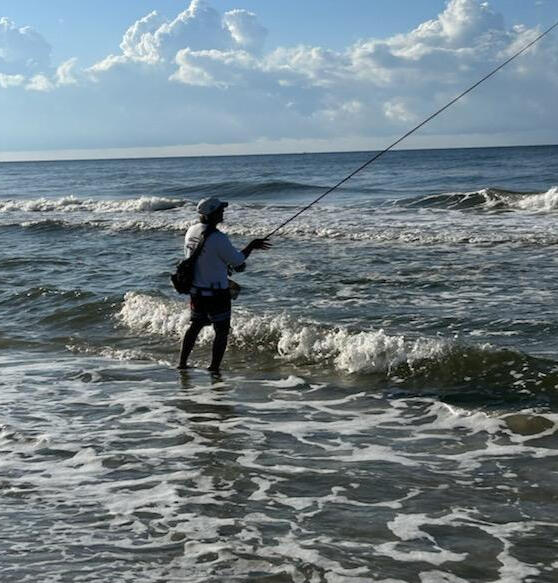
Surf Spey Weight Transfer MechanicsHow Foot Pressure, Hip Rotation, and Lower Body Geometry Control Sweep Height, Turn Radius, Drift Stability, and Forward Stroke AlignmentSurf Spey casting does not begin with the rod. It begins with the ground.Stance establishes the caster’s geometric base. Weight transfer determines how that geometry moves through the Sweep, Turn, Drift, and Delivery.Lower body mechanics are the foundation of Surf Spey. They control rod tip height, Turn radius, apex stability, and forward stroke alignment.This article defines the Surf Spey weight transfer system and explains how the feet, legs, and hips drive the cast.THE PURPOSE OF WEIGHT TRANSFERWeight transfer establishes:
• stability against wave surge
• the height and width of the Sweep
• the radius of the Turn
• the stability of the Drift
• the direction of the inward Pull
• the plane of the forward strokeStance is static. Weight transfer is dynamic. Together, they define the lower-body architecture of the cast.THE WEIGHT TRANSFER CHAINSurf Spey lower body mechanics follow a strict chain:
Feet → Knees → Hips → Torso → Rod TipWhen this chain moves in sequence, the rod tip travels a clean, rising path. When any link breaks, the rod tip collapses, drifts diagonally, or loses tension.The lower body determines the rod tip’s freedom.1. FOOT PRESSURE CONTROLS SWEEP HEIGHT
Lead Foot Pressure
• raises the Sweep
• supports a tall Turn
• stabilizes Drift height
• promotes a high apexRear Foot Pressure
• lowers the Sweep
• narrows the Turn
• reduces Drift height
• produces a flatter apexSurf Spey requires a rising Sweep. This means the caster must bias pressure toward the lead foot as the Sweep begins.Foot pressure is Sweep geometry.2. WEIGHT SHIFT CONTROLS TURN RADIUSOpen Stance → Lateral Weight Shift
• wide Turn
• tall apex
• rotational freedom
• high Drift stabilityClosed Stance → Forward Weight Shift
• compact Turn
• disciplined apex
• straight forward stroke plane
• natural inward Pull vectorThe stance determines the direction of the weight shift. The weight shift determines the Turn radius.Turn radius is lower body driven.3. HIP ROTATION CONTROLS THE TURN AND THE DRIFTThe hips are the pivot of Surf Spey.
Active Hip Rotation
• widens the Turn
• raises the rod tip
• supports tall Drift
• maintains tension through theTurn
Neutral Hips
• narrow the Turn
• lower the rod tip
• reduce Drift height
• require more torso correction
Hip rotation is apex control.4. LOWER BODY STABILITY CONTROLS DRIFT HEIGHTDrift is not an upper body mechanic. It is a lower body mechanic expressed through the rod tip.Stable Lower Body
• tall Drift
• high apex
• clean Float
• predictable forward stroke planeUnstable Lower Body
• collapsing Drift
• wandering apex
• diagonal forward stroke
• inconsistent tension
Drift height is determined by the hips and feet, not the hands.5. FOOTWORK CONTROLS FORWARD STROKE ALIGNMENTThe forward stroke inherits the lower body geometry.Open Stance
• rotational forward stroke plane
• wide delivery rail
• tall apex inheritanceClosed Stance
• straight, level forward stroke plane
• disciplined delivery rail
• strong inward Pull vector
Forward stroke alignment begins at the feet.6. LOWER BODY MECHANICS AGAINST WAVE SURGEThe wave cycle acts on the caster as much as the line.Push
Absorb with knees and hips. Do not begin the Sweep.Peak
Stabilize feet and hips. Preset tension in the air.Wash
Anchor the lower body. Let the line drift.Drawback
Shift weight, rotate hips, deliver the cast.
Lower body mechanics synchronize the caster with the wave.7. WEIGHT TRANSFER DETERMINES APEX HEIGHTApex height is not created by the hands. It is created by:
• lead foot pressure
• lateral or forward weight shift
• hip rotation
• lower body stability during DriftHigh apex = disciplined lower body. Low apex = collapsing lower body.
Apex height is a lower body product.HOW TO CHOOSE YOUR WEIGHT TRANSFER PROFILEChoose a lateral weight transfer profile if your stroke is:
• tall
• rotational
• wide
• dependent on high Drift/Float
• built on a rising SweepChoose a forward weight transfer profile if your stroke is:
• compact
• inside supported
• torso driven
• dependent on a straight forward stroke plane
• built on a disciplined inward PullIf unsure, begin with closed stance + forward weight shift + squared torso. This produces the most stable forward stroke plane and the cleanest alignment chain.CLOSING
Surf Spey stance is the geometric base. Weight transfer is the dynamic engine.The feet control Sweep height. The hips control Turn radius. The lower body controls Drift stability. The alignment chain controls the forward stroke.Surf Spey lower body mechanics are not style choices. They are structural decisions.When stance and weight transfer are correct, the rod tip travels a clean, rising path that supports high apex Surf Spey casts.Choose the weight transfer profile that matches your mechanics and preserves alignment.

SURF SPEY UPPER BODY GEOMETRYHow Torso, Shoulders, and the Shoulder Seam Complete the Alignment ChainTHE ROLE OF THE UPPER BODYStance establishes the geometric base. Weight transfer moves that base through the Sweep, Turn, Drift, and Float. The upper body determines whether that geometry reaches the rod tip intact.Upper body geometry controls:
• the delivery rail
• the forward stroke plane
• apex trajectory
• inward Pull direction
• rod tip stability during DriftWhen the upper body is aligned, the rod tip rises cleanly and returns predictably. When it breaks alignment, the rod tip collapses into diagonal tension loss.THE UPPER BODY CHAIN
Torso → Shoulders → Shoulder Seam → Arms → Hands → Rod TipThis chain must remain intact for Surf Spey mechanics to function.Torso
Sets the forward stroke plane. A squared torso produces a straight delivery rail. A rotated torso produces a wide, rotational delivery rail.Shoulders
Define the rod tip corridor. Shoulders aligned with the target line keep the rod tip level and rising.Shoulder Seam
The vertical plane the rod tip must return to before the forward stroke. It is the upper body anchor that stabilizes:
• apex height
• Drift
• Float
• inward Pull vector
• forward stroke alignment
If the rod tip is off the seam, the forward stroke collapses.Arms
Set the rod‑tip trajectory.
Surf Spey uses a collapse‑arm path, not a wide arm path.Hands
Refine the tension vector. Top hand sets apex height. Bottom hand sets Pull direction.Rod Tip
The final expression of the entire chain.THE THREE LAYER GEOMETRY MODEL
Surf Spey mechanics operate through three stacked layers:
Layer 1 — Lower Body Geometry
Feet, knees, hips → Sweep height → Turn radius → Drift stabilityLayer 2 — Upper Body Geometry
Torso, shoulders, shoulder seam, arms, hands → forward stroke plane → delivery rail → apex trajectoryLayer 3 — Rod Tip Geometry
Rod tip path → directional tension → forward only plane → apex heightWhen all three layers align, Surf Spey produces clean, high apex casts.CLOSING
Lower‑body mechanics create the base.
Upper‑body mechanics transmit that base into the rod tip.Feet → Hips → Torso → Shoulders → Shoulder Seam Plane → Rod TipWhen the rod tip aligns with the shoulder‑seam plane before the forward stroke, stance and weight transfer produce clean, high‑apex Surf Spey casts.